Thursday, 21 June 2012

Political Geography and Indigenous Languages

Although Spanish and Portuguese are the two most widely spoken languages in Latin America, there remain many smaller scale indigenous languages within the region. French, Dutch and English are also present throughout some Latin American countries, such as French Guiana, Suriname and Guyana, respectively. Latin American history can easily be observed through the major languages spoken within specific countries. Former Spanish colonies such as Mexico, Peru, Chile and Paraguay, to name a few, now hold Spanish as an official language. One of the major former colonies of Portugal; Brazil, has adapted Portuguese as its official language. Mexico, alongside its official language of Spanish, carries several different official indigenous languages, which represents the importance and emphasis the country has placed on its indigenous peoples.  Language, considered to be the most fundamental aspect of any culture, undoubtedly represents a piece of history. Language, as well, can intensify the feeling of unity and nationalism among specific groups of people. It also has the ability to strengthen ones feeling of individualism, becauseas as we know it, language is unquestionably the backbone of self identity, as it represents a persons heritage.

Map of some of the major various language families in Latin America. Mayan languages are present within Mexico all the way down to Panama. Andean langauges are primarily found within Ecuador and surrounding areas. Other language families can be found scattered throughout Latin America, primarily where indigenous inhabitants are present.


Former Spanish colonies such as Mexico, Peru, El Salvador and Chile now have Spanish as their official language. As mentioned, the colonization and history of the past is reflected among the languages spoken today within the region.


Among the regions with major indigenous populations, we see an increased presence of their mother languages. Mexico would be considered a perfect example, holding over 60 official indigenous languages.


Wednesday, 20 June 2012

Social Movements in Latin America

Social movements are an important part of Latin American history, as they advocated desired changes among Latin society, sometimes with little or no violence. Important social movements in Latin America are usually a response to government policies, as well as economic downfalls, but can also be triggered by racial inequality and discrimination. Latin society encountered a range of movements, from labor to feminist to human rights. Nationalist movements that arose in Latin America were some of the most important in the region, which opted for an increased feeling of nationalism and the removal of imperialism. Major dissatisfaction may sometimes lead to a revolution, as seen in Cuba. Other movements, such as the Labour Movement, opt for economic changes, which target poverty, fairness among working classes and unions. Newer social movements, such as the feminist movement, advocate stepping away from the usual male dominated society and creating recognition, equality and appreication towards women. Countries such as Mexico, all the way down to Chile, have witnessed and experienced social movements of all types, all in efforts to advocate and bring about changes to meet their essential needs.

"The July 26th Movement" is one of the most celebrated and revolutionary socialist movements in Cuban history. Primarily organised and lead by Fidel Castro, he and 81 other revolutionaries successfully overthrew the notorious dictatorship lead by Fulgencio Batista. Despite the many deaths, failures and imprisonments Castro and his fellow revolutionaries witnessed and experienced themselves, their determination to overthrow the infamous dictator never wore off. A movement such as this reveals just how important it is to not only Fidel Castro, but many other Cubans, to sustain their rights and maintain equality.


The Feminist Movement of Latin America was a social movement that had not been witnessed by much of society, due to the fact that womens rights were restricted. The goal of this movement was to encourage and reveal the identity of women, as well as to challenge "manchismo"; intensive masculine pride. Many aspects of society were questioned and challenged, such as why women did not recieve adequate education, why they were restricted from employment, and why their reproductive rights were poorly set, to name a few. The feminist waves that occured throughout Latin America are considered to be a turning point for women, as these events revealed the demand for womens rights and freedoms.


Environmental concerns have recently been uprising throughout Latin America, not only to protect ecological systems and important resources, but also to protect sacred cultural sites for indigenous groups, primarily those residing in the Amazon region. Many people throughout Latin America have come together, with the use of campaigns and social movements, to draw attention to their environmental concerns. Governments have begun to take action, and millions of dollars have been spent in efforts to protect the Latin American land and resources. Throughout the past, the environment was not made a priority and was lacking the proper care needed, but now, with the attention recieved from the creation of social movements and organizations, awareness has successfully been made.


Since the Industrial Revolution in England took its course throughout the world, labour movements and workers demands for rights have been springing throughout Latin America. Ideologies such as Anarchism and socialism were the guiding factors behind the labour movements that took place. Workers from all fields, such as dockers, oil workers and miners expressed their concerns and demands throughtout the entire region of Latin America, but primarily in areas such as Argentina, Brazil and Mexico where populations were high and workers were plentiful. The unity that these movements created is magnificent. Workers not only in Latin America, but throughout the world, shared a sense of collective identity, as they were the ones that guided the worlds economy. The demand for liberty was put forth in the eyes of the Latin American community. Countries such as Columbia worked towards meeting the needs of their workers, by providing essential needs such as water and electricity. The labor movements were so influential throughout Latin America that workers were considered in poltical decisions and policies. Workers finally began to get the attention from governments that they for so long desired.

Mundo Quino

Joaquin Salvador Lavado, popularly known as "Quino" is considered to be one of the best (if not the best) Latin American cartoonists. His work consists of mild humor about vast ideas and incidents occuring in the world. Not all his cartoons consist of texts or dialogues, which may suggest his wish for the audience to assume the message he is trying to convey, or to simply use ones own imagination towards grasping a message from his cartoons. Quino's most popular comic strips known as "Mafalda", reveal his thoughts and opinions towards global issues such as the environment, peace and society, with little or no wording.

One of Quino's Mafalda comic strips, we see a flower pot being placed next to a globe representing earth, while the girls steps down to tie her shoelaces. By the time she stands back up, the flowers have dried up and died. The main message being exposed through this strip is that the world faces many problems and predicaments. Issues such as global warming, violence, poverty and racism are present in our world today. The presence is so widespread, that it affects us all, no matter what side of the globe we are on. The dying flower can be thought of as a medaphor to represent this simple fact; being exposed to globe, the flower withers and dies. Personally, I believe Quino is expressing to us his concerns about the world, in efforts to gain our attention towards global issues.

Latin American Painters

Considered to be one of the best known and respected female artists in Latin America, Mexican painter Frida Kahlo gives women recognition, not only in Latin America, but throughout the world. Her paintings are not simply just colors on walls, her paintings tell stories of thousands of words. Her paintings tell stories of her life, from the hardships that she encountered, to the life that she adapted  from the pain that she suffered from her accident and her marriage problems. During years in which women did not have much identity and recognition, Kahlo's art worked towards proving to society that women were just as capable as men, that they were just as intelligent and could achieve great things. Kahlo's stories through her magnificent art support the identity of her and other women throughout Latin America and around the world.


Diego amd I (1949)
A painting made by Kahlo during the time her husband, Diego Rivera was having an intimate relationship with another woman. The tears represent her feeling of sadness, neglect and betrayal. The dark colors and nightly tone give off a very bold and intense mood, such as anger. Kahlo's blank yet hypnotizing stare reveal to the viewer a sense of shock that she may have experienced during the time. The intense, emotional roller coaster that Kahlo was forced to experience is represented excellently in this piece of art. A story of sadness and heart break is written within the colors of this picture.

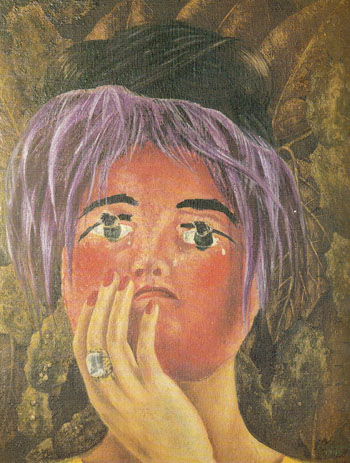
The Mask (1945)
A painting which doesn't directly reveal Kahlo's emotions, in that she is behind a mask, which makes us unaware of her true feelings. The mask may suggest that Frida is left to put forth false emotions to those around her, when really, on the inside she is left to suffer from emotion pain. The neglect, heart break and sadness that Kahlo experienced throughout her past remain trapped inside of her forever, forcing her to put on a front. The unusual purple hair may show signs craziness and confusion, with a mind that lacks proper senses. The darkness in the background sets a mood of depression, loneliness and abandonment. This painting is obviously a response to the actions of her husband, Diego Rivera and his scandalous affair.

The Two Fridas (1939)
Again, a painting telling a story of her husband Diego Rivera. A bold work of art which represents two completely different Frida's. One that Diego Rivera was in love with, and one that he was not in love with. This again was obviously created after Frida's divorce with Diego. On the right, we see a Frida dressed in cultural Mexican clothing, who holds great pride and identity. This was the women that Diego Rivera was once so madly in love with. On the left, there is Frida who modernised in European clothing, chic and elegant. A false Frida, who did not capture the love of Diego Rivera. The dark and cloud sky behind the two Frida's represent feelings of loneliness and hurtfulness. Similar to many of Frida Kahlo's other works of art, her feelings and emotional distress are vividly portrayed.


Frida's ex-husband, Diego Rivera was also a widely known and very respected painter/muralist of Latin America since the age of 16. His works included and revealed large amounts of Mexican history and values, especially those of the revolution, which made his work primarily responsible for gaining the worlds attention on Mexican traditions and culture. Diego's painting unquestionably depicted both the emergence and extinction of certain Mexican traits, making his work seem as if it were a timeline of Mexican culture. Diego's prime goal throughout his artwork, as it undoubtedly seems, was to give Mexicans pride in their rich culture and history.


The Painters Studio (1954)
The importance that art and paintings play in Rivera's life are represented greatly in this mural. The spacious setting represent this room as his "open" sanctuary. The odd looking shapes and creatures in the background represent his artistic and colorful approach that he leads with his artwork. While the model laying on the chair, may represent a sexual and explicit side of Rivera. The fact that he even took the time to create a mural of his work place tells us alone that this space of his is indeed a fundamental aspect of his life.


The History of Mexico - The Ancient Indian World (1929)
As we know, Rivera is very passionate about his Mexican culture and traditions. This famous mural created by him reveals the struggles of the Mexican people, while still providing hope for the future with the image of a bright and large sun, that may be used as a symbol for guidance. The man portrayed as a god-like figure at the top right corner, is contradictory to Rivera's beliefs, considering that he is a strict athiest. An absolute meaning of this painting may not be determined, but the message is clear; Mexico faces struggles and hardships, but hope and faith, the future of Mexico will undoubtedly be brighter.


May Day Procession in Moscow (1956)
The Moscow May Day celebration parade, represented in the mural, depicts feelings of peace and belonging. Peace is primarily emphasized, considering that it is written on the blue ball. Having recieved cancer treatment in the Soviet Union (now Russia), Rivera may have felt an intensified feeling towards the appreciation of life, which lead him to advocate peace and tranquility within the world.

Sunday, 27 May 2012

Latin Music

Map of musical styles in Latin America. There are a number of different musical styles present within Latin America, originating in various countries. Despite the variations and differing origins, Latin Americans are familiar with them all, which leads to a feeling of a unified culture.

Salsa Youtube Link:
The Salsa originated from the Cuban Son, as well as jazz. It has deep and traditional roots in Cuba and is seen as being a very energetic and fast paced music and dance style. It arose quit quickly by Latin immigrants playing the music in New York. Today, it is considered the ``modern`` version of the Cuban Son! The city of Cali in Columbia is noted as being the unofficial ``capital of Salsa``.

Cumbia Youtube Link:
Cumbia originally arose in Panama, and revealed itself all throught Latin America. Now, it is the national music of Columbia. Cumbia is similar to Salsa, in that it is somewhat fast paced and energetic. It was originally a type of folk music, which was mainly composed of entenderes (concerns of everyday life in Columbia).

Bolero Youtube Link:
Bolero is a very romantic and slow paced type of music. In the video, it is quite evident how intimate this music style really is. Bolero originated in Cuba in the 19th century, and had its golden years between the 1930`s and the 1950`s.

Danzon Youtube Link:
The Danzon originated in Cuba, but is very widespread and popular among the Mexicans and Puerto Ricans. It is a slow form of Latin ballroom dancing, and is based on a French style courtly dance. The dancers avoid direct eye contact, due to the emphasis the music has on modesty.

Mambo Youtube Link:
The Mambo style originally arose in Cuba, and became popular with the help of Perez Prado. Mambo is quite fast paced and interactive, which makes it similar to Salsa in many aspects.

Merengue Youtube Link:
Merengue is a music style which has its roots in the Dominican Republic. The beat and pace of Merengue is quite fast, but the dance is not as fast paced.

Vallenato Youtube Link:
Vallenato is a Columbian style of folk music, very similar to Cumbia. The literal meaning of Vallenato is ``born in the Valley``. This music was essentially used a story telling device.

Tango Youtube Link:
The Tango originated in Buenos Aires, Argentina. In the video, we see that this type of musical style is intimate and interactive between both partners.

Ranchera Youtube Link:
Ranchera originated in Mexico, and is very traditional and well loved among the Mexicans. It involves the use of a quitar and is typically performed by one person, although this is not always the case (such as in the video).

Bossa Nova Youtube Link:
http://www.youtube.com/watch?v=ksf6b98g-sg
Bossa Nova is a popular musical style which emerged in Brazil during the 1950`s. The term literally means ``new trend`` and is a combination of both jazz and samba.


Many of the Latin musical styles known to us today, originated in and around the Antilles, most noticeably Cuba. The various forms of Latin music represent the importance of entertainment in Latin American culture. Although the musical styles have various origins, they are all popular among Latin Americans, despite the country, which intensifies the feelings of unity. Sharing many forms of music and dancing bring together people of various countries and advocates the feeling of collective identity. 

Brigadeiro Recipe

Here is the Youtube link for the recipe :)

Brigadeiro is a simple, yet very delicious Brazilian chocolate truffle. It first emerged around the 1940`s and was named after a popular Brigadier general named Eduardo Gomes, who is said to have had a sweet tooth for chocolate! This sweet dish is believed to have been greatly a result of the Nestle brand emerging in Brazil during the time it was introduced. Brigadeiro is most often found at special functions, especially birthday parties.

File:Brigadeiro.jpg
The sweet and pleasant Brigadeiro!


Poem Analysis

Everything Changes (Todo cambia)
By Mercedes Sosa
Everything Changes
That which is superficial changes

Also that which is profound

the way of thinking changes

Everything in this world changes
The weather changes as the years go by

The shepherd changes his flock 
and just as everything changes

the fact that I change it's not in the least strange
The finest diamond changes its brightness
 as it travels from hand to hand

the bird changes its nest

So does a lover change the way he feels
The traveler changes his path 
even if this proves to be harmful

and just as everything changes
 the fact that I change it's not in the least strange
Changes, everything changes
The sun changes its course
 to give way to the night
The plant changes and gets dressed in green
 during spring
The beast changes its fur 
the hair of an old person changes

and just as everything changes 
the fact that I change it's not in the least strange
But my love doesn't change 
no matter how far away I find myself

neither the memory nor the pain
 of my country and my people
What changed yesterday
 will have to change tomorrow

Just as I change
 in this foreign land
Changes, everything changes
But my love doesn't change
 no matter how far away I find myself

neither the memory nor the pain
 of my country and my people
Changes, everything changes


The very first line of this beautiful poem by Mercedes Sosa reveals an inevitable fact of life; change. Change is all around us, every person on earth changes, as well as the country they reside in. Sosa's attitude comes off as very affirmative throughout the entire poem, and her use of simple and direct diction sets off an immediate tone of explicitness. There is no doubt that this poem clearly indicates the history and changes that the entire Latin region of the world has undergone. The fourth line: "the way of thinking changes" addresses the cultural, social and religious changes that the Latin people were forced to adapt to during the past conquests that took place within the region. The repeated line: "the fact that I change its not in the least strange" (first beginning on line 8) conveys a sense of vulnerability to the reader, as it suggests the abundant impact that all the changes in the Latin region (specifically her home country, Argentina) had on all of its people. As a country is exposed to changes, so too is its people. The line after 8: "the finest diamond changes its brightness as it travel from hand to hand" may be thought of as a metaphor to represent the slaves that were taken advantage of during British and Spanish invasions of South America, as well as the social inequality present in the region during the time. The ``finest diamonds`` being the slaves, which moved ``hand to hand`` (owner to owner), which slowly erroded their ``brightness`` (confidence and sense of self). Another important line, which is on line 12: "the traveler changes his path even if this proves to be harmful" may also be thought of as a metaphor to represent the uprisings of the Latin peoples and the various attempts at gaining independence. Although harmful and rebellious, the movements towards independence from the indigenous peoples were a starting point in gaining back their sense of individuality and nationalism from those who controlled their lands. Sosa`s compassionate line towards the ending of the poem: "but my love doesn`t change no matter how far away i find myself, neither the memory nore the pain of my country and my people" (repeated on lines 19 and 24) reveals her sense of dignity and faithfulness towards her country. As many hardships and troubles that the country of Argentina as well as the rest of the Latin region faced, the love for the land in which your heart and soul was raised never dies, nor does the love for your people. As much pain and suffering that the people of any land may face, the love still remains and the faith that you hold towards your land may help in enduring the burdens placed upon you in times of crisis. Sosa reveals to the readers of this poem, the thoughts of not only her people, but the entire Latin population who had gone through similiar adversities and challenges. Her positive and faithful attitude throughout the poem reveal her continuous sense of pride and unity, which is essential in overcoming hardships and negative changes.